🎨 What’s In: The Rise of Purpose-Driven Design
The most dominant trends in 2026 are not just about how a website looks, but how it feels and functions. Designers are embracing a minimalist ethos that prioritizes clarity, speed, and genuine connection.8
- Bento Box & Structured Minimalism: The cluttered, endless scroll is giving way to highly organized, grid-based layouts.9 Inspired by the Japanese bento box, this design style neatly arranges content into distinct, visually separate compartments.10 This approach makes information easy to digest, reduces cognitive load, and naturally guides the user’s eye. Paired with ample white space, it creates a sense of calm and efficiency.
- Bold Typography as a Statement: With cleaner layouts, typography is stepping into the spotlight.11 In 2026, text isn’t just for reading; it’s a primary visual element. Expect to see oversized, expressive, and even mismatched fonts used to create a strong brand identity and draw attention to key messages.12 It’s a powerful way to convey a brand’s personality without relying on heavy graphics.
- Subtle & Purposeful Motion: Flashy, in-your-face animations are out. In their place, web design is embracing micro-interactions and subtle motion that serves a purpose.13 This includes hover effects that provide immediate feedback, scroll-triggered animations that guide users through a narrative, and seamless transitions that create a fluid journey.14 Motion is now a tool for storytelling and usability, not just a visual gimmick.15
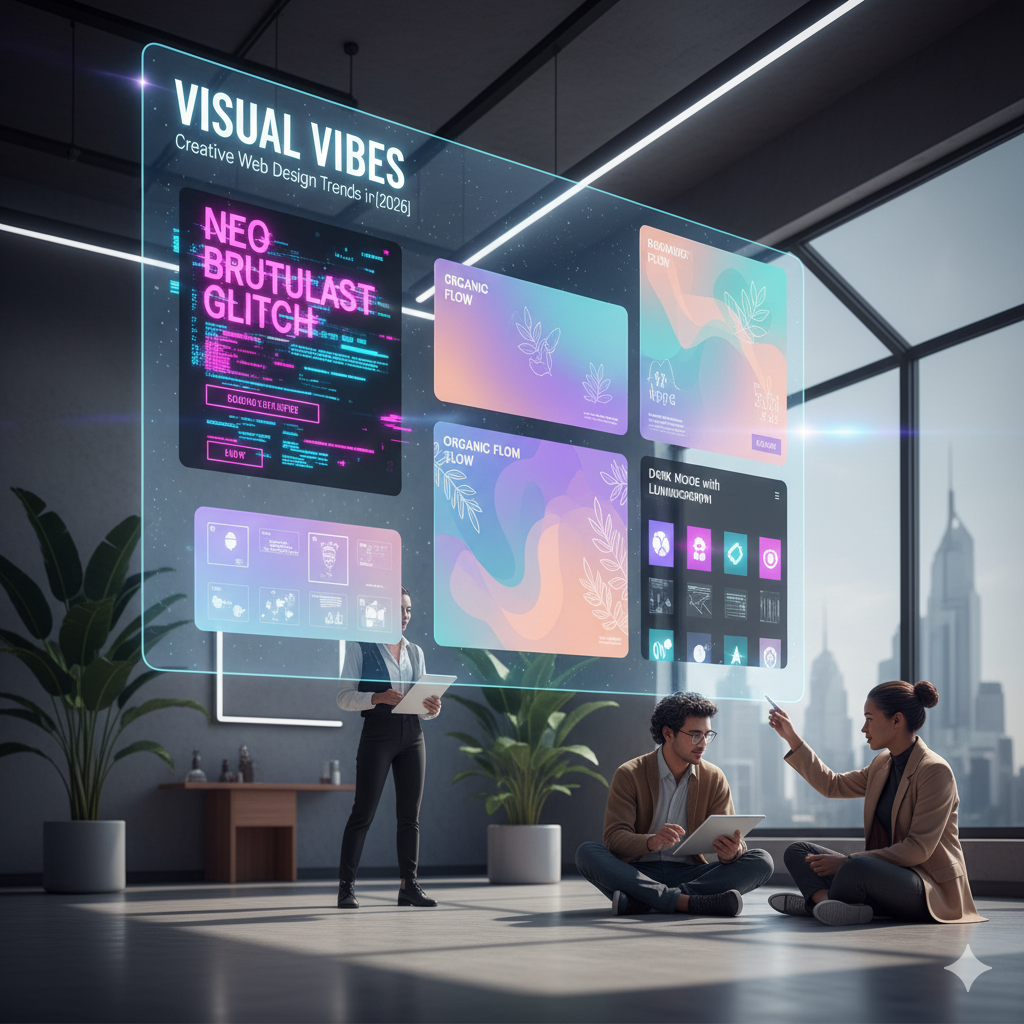
- Organic & Fluid Shapes: As a counterpoint to the structured grids, designers are using soft, flowing shapes and gradients that feel more natural and human.16 From asymmetrical layouts to wavy dividers and soft-edged buttons, these organic forms break the rigid, angular mold of the past.17 This trend creates a gentler, more approachable aesthetic that feels less like a machine and more like a living thing.18
❌ What’s Out: The End of Digital Excess
The web is shedding its digital baggage. Designs that prioritize style over substance and speed are quickly becoming obsolete.
- Overly-Cluttered & Visually Noisy Sites: The era of cramming every available pixel with content is over.19 Websites with jarring pop-ups, multiple competing animations, and an overwhelming number of elements are losing out. Users are impatient and will quickly abandon a site that feels difficult to navigate or process.20
- Static Branding & Fixed Logos: A brand identity that is completely rigid is a thing of the past. In an age of dynamic and personalized content, brands need to be able to adapt. Logos and color palettes that don’t have a “dynamic ecosystem” to evolve or change with the user experience will feel outdated and uninspired.
- Non-Accessible Designs: The days when accessibility was an “optional extra” are long gone.21 With the increasing push for digital inclusivity, websites that are not built from the ground up to be accessible to all users—regardless of ability—will be seen as not only un-ethical but also un-professional.22 Lack of keyboard navigation, poor color contrast, and non-descriptive alt-text are no longer acceptable.23
🔮 What’s Next: A Human-Centric, AI-Powered Future
Looking beyond the current wave of trends, the future of web design is a seamless blend of cutting-edge technology and deep human empathy.
- Hyper-Personalized, AI-Driven Interfaces: AI is set to revolutionize the user experience by making it feel truly personal.24 We’re moving beyond simple product recommendations to interfaces that can adapt in real-time based on a user’s behavior, mood, or context.25 An AI-powered website might change its layout, simplify its content, or even adjust its color palette to provide the most optimal experience for each individual visitor.26
- Voice-First & Invisible Interfaces: The mouse and keyboard will no longer be the only way to interact with a website.27 Voice user interfaces (VUI) are becoming a standard feature, allowing users to navigate and interact with sites using natural language.28 The ultimate evolution of this is the “invisible interface,” where the user’s intent is so well-understood that the UI disappears, providing an experience that feels like pure, frictionless action.
Sustainable Web Design: With growing awareness of the internet’s environmental impact, the “digital ecological footprint” is a major concern.29 Future web design will prioritize sustainability through energy-efficient coding, optimized image sizes, and the use of “green” hosting services powered by renewable energy.30 A faster, lighter website is not just good for business—it’s also good for the planet.